


When gamers think of world-building, farming, and life simulators, Harvest Moon often rises to the top of the mind. Its tranquil pace, immersive seasonal changes, character bonds, and satisfying progression have inspired countless spiritual successors and indie experiments. Lately, as artificial intelligence continues to weave its way into nearly every corner of creative work, a fresh contender has captured attention: Joyland AI. In this article, we will explore how Joyland AI channels the spirit of a game like Harvest Moon, what sets it apart, and why it might be a compelling addition to your library.
What Is Joyland AI?
Joyland AI is a novel, experimental simulation environment powered by advanced AI techniques. At its core, it’s a life-simulation sandbox. It was designed not just with static programming, but also with dynamic AI agents and emergent behaviors. In traditional game like Harvest Moon non-player characters (NPCs) are pre-scripted. Joyland AI, by contrast, features characters who have motivations, adaptability, evolving relationships, and self-driven routines—or at least, that is the design ambition.
Transitioning from the technical aspects, it’s worth considering how these features come together in practice. The developers present Joyland AI as a space where the environment, characters, and player interactions evolve over time. You might arrive on day one to quiet fields and sparse dialogue, but as days pass, new story threads can emerge, relationships deepen, and events unfold in unexpected ways. In that sense, Joyland AI seeks to be more than “just another farm game”—it aims for generative narrative, replayability through variation, and a simulation that feels alive.
Why Joyland AI Appeals to Fans of Game Like Harvest Moon
1. Emphasis on Life, Farming, and Relationships
What draws many players to game like Harvest Moon and similar games is the balance between farming, socializing, and progression. You plant crops, care for animals, explore the land, and build bonds with village characters. Joyland AI taps into the same core loop. You still manage your land, make decisions about planting or harvesting, explore nearby areas, and choose whether or not to engage with other AI agents.
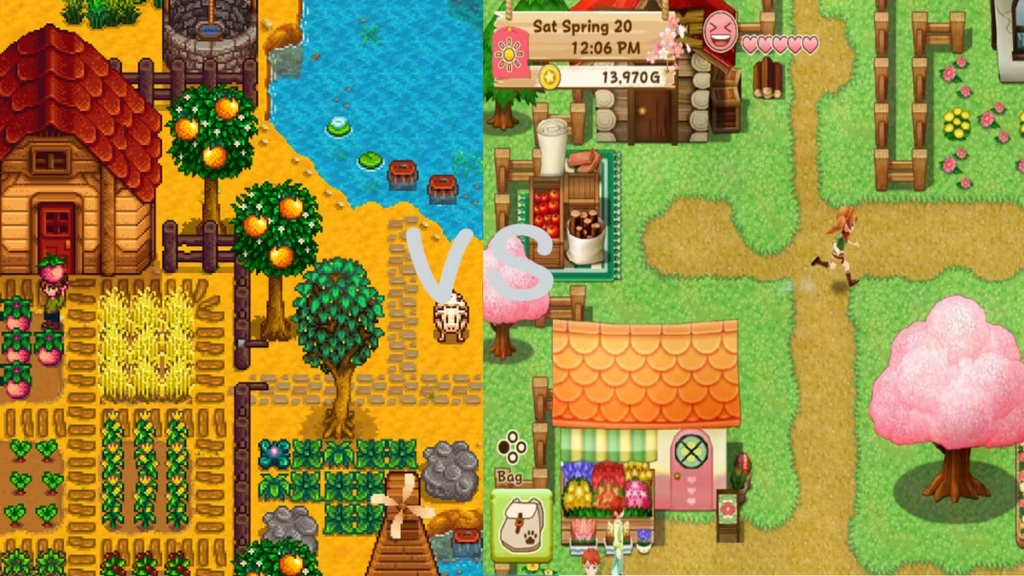
The difference is in the depth: NPCs in Joyland have their own autonomy. They might pursue goals, change routines, or initiate events toward you or among themselves, giving a sense of a living village, rather than static dialogue trees.
2. Emergent Narratives Over Scripted Storylines
Traditional farming sims often rely on scheduled festivals, fixed character arcs, and set “events” that always occur after certain triggers. In Joyland AI, while there may be seeds of design (pun intended) for events, the hope is that many narrative threads emerge from the interplay of AI agents, environment, and player actions. You might inadvertently trigger a friendship, rivalry, romance, or quest that was never hard-coded.
For fans of game like Harvest Moon who have often wished for surprises—or for days when the village feels more vibrant—Joyland AI holds promise as a dynamic canvas rather than a predictable grind.
3. Freedom and Replayability
One of the challenges with farming/life sims is replay fatigue: after a few runs, the world may start to feel repetitive. Since Joyland AI’s design is generative, each playthrough can diverge. NPC behavior may differ, relationships may develop along new paths, and the land may evolve in unexpected ways. The result? A more open-ended experience where the phrase “a game like Harvest Moon” truly stretches beyond mimicry into innovation.
4. AI-Driven Environment
Joyland AI doesn’t just invest in AI agents; the environment itself can react. Weather, seasons, wildlife behavior, resource cycles, and perhaps even rumors or social trends can shift in response to what’s happening. This adds layers of complexity: perhaps an agent will ask you to help with a wild animal problem, or crops may suffer due to emergent pests influenced by broader AI systems. The result is a dynamic “world” rather than a static backdrop.
Key Features and Mechanics (Real or Anticipated)
Below, we outline anticipated mechanics (some speculative, depending on development state) and how they bridge Joyland AI and a game like Harvest Moon:
A. Farming & Resource Management
- Crop cycles and seasons: You’ll sow seeds, water, fertilize, and harvest. Some crops thrive in spring, others in autumn.
- Animal husbandry: Cattle, chickens, sheep, or even fantasy creatures may need feeding, care, and barn upgrades.
- Crafting & production: Raw harvests could be turned into goods—jams, cheeses, fabrics—to sell or gift.
- Resource gathering: Wood, stone, forage, or rare materials may be collectible around the map or during exploration.
B. Autonomous NPCs & Relationships
- Agent motivations: NPCs might have ambitions (career, family, adventure) and adapt over time.
- Dynamic schedules: Rather than fixed routines, agents might choose paths each day depending on mood or priorities.
- Emergent romance, friendship, rivalry: NPCs could initiate conversations, hint at feelings, or shift alliances.
- Player influence: Your actions—gifts, dialogue, deeds—may shift agent paths, but agents retain autonomy.
C. Events & Story Seeds
- Non-deterministic events: Rainstorms, wildlife intrusions, small village conflicts, or forgotten artifacts may appear spontaneously.
- Quest generation: Rather than hand-written quests only, procedural or AI-driven prompts may arise (e.g., help NPC A find a missing item, assist with a festival idea).
- Seasons and festivals: Some festivals or celebrations may still exist, but the timing or structure could shift.
D. Exploration & Expansion
- New lands or biomes: As your farm grows, you might unlock forested areas, caves, or shores.
- Discovery mechanics: Hidden resources, relics, or sub-areas may reveal themselves through exploration or agent suggestions.
- Connection with agents: NPCs could ask to explore with you or lead you to interesting spots.
E. Adaptivity & Replay Logic
- Behavior over time: NPCs may grow older, change preferences, or even relocate.
- World memory: The world “remembers” your influence—if you clear a forest for farmland in one run, in the next run that forest might remain or shift.
- Branching possibilities: The culmination of NPC arcs, environmental shifts, and player choices forms unique endpoints rather than fixed endings.
Comparing Joyland AI with Other “Games Like Harvest Moon”
To appreciate Joyland AI’s aims, it helps to contrast it with notable peers:
- Stardew Valley / Story of Seasons: These remain staunch benchmarks for “a game like Harvest Moon.” Their strength is in polished mechanics, defined storylines, and rich character interactions. Their limitation is that villages and story arcs are largely static after a while.
- My Time at Portia / Spiritfarer: These lean more heavily into crafting, exploration, or narrative arcs, moving somewhat away from pure farming. They offer variety, but often fewer surprises regarding NPC autonomy.
- Don’t Starve / Graveyard Keeper: These reinterpret the farming/life sim theme with darker or niche twists, but not always with deep NPC relationship systems.
Joyland AI’s unique proposition lies in agent autonomy and emergent worldbuilding. Where other games define the narrative first and mechanics second, Joyland AI seems to invert that: mechanics + AI interactions create narratives on the fly. For players who love game like Harvest Moon but have felt constrained by predetermined arcs, Joyland AI could be the bridge to open-ended, evolving life simulation.
Potential Challenges & Design Risks
Of course, ambitious AI systems carry risks. Some anticipated challenges:
1. Coherence vs Chaos
If NPCs and the world evolve too freely, the experience might devolve into chaos—characters vanishing, story threads dangling, inconsistent behavior. The design challenge is balancing emergent behavior with bounds that maintain narrative coherence.
2. Scalability & Performance
Simulating many intelligent agents and reactive systems in real time is computationally taxing. Efficient algorithms, event pruning, and thoughtful world partitioning are key to ensuring smooth gameplay.
3. Player Agency vs Overdetermination
Players should feel their actions matter, but if agents always “do their own thing,” the player might feel sidelined. The system must allow sufficient leverage for the player to influence the world meaningfully.
4. Emotional Attachment & Character Depth
Emergent systems may struggle to replicate the emotional, well-written character arcs that handcrafted designs excel at. Some NPCs might feel flat or less memorable. Designers might need to overlay scripted character “flavor” atop generative behaviors.
5. Replay vs Fatigue
While replayability is a goal, if too much randomness occurs without coherent structure, players might feel disoriented or find no long-term goals. Striking the right balance in world structure, progression locks, and narrative seeds is essential.
Tips for Players: How to Play Joyland AI as a “Game Like Harvest Moon”
- Start small, expand slowly.
Begin with a modest patch of farmland. Cultivate relationships with one or two NPCs before branching out. Let the world unfold organically. - Observe before acting
Spend days just watching NPC behavior, their routines, where they go, what they do. By understanding patterns, you can better intervene or assist in emergent events. - Interact, but don’t force control.
Use dialogue, gifts, or decisions to influence agents, but be careful not to dominate. The beauty lies in that balance. - Experiment across runs
Because each playthrough can differ, try divergent strategies—focus on social ties, or pure agriculture, or exploration—to see how the world responds. - Log events & stories.
As emergent narratives arise—friendships, conflicts, quests—document them (in screenshots or journals). These emergent threads are part of the joy of Joyland AI. - Be okay with surprises.
Some events may catch you off guard—NPCs doing things you didn’t expect, your farm destroyed, or new characters showing up. Embrace the unpredictable.
Sample Narrative: A Day in Joyland AI
Imagine a morning break of dawn in your Joyland AI world. You rise, water a row of radishes, check your chicken coop, and notice one hen is missing. Curious, you wander into the forest edge. Meanwhile, NPC “Elinor,” whom you recently helped mend a fence, is venturing outside her home in search of wild mushrooms. As pathways intersect, you overhear two NPCs conversing about a local bear sighting.
You decide to escort Elinor back through the deep woods to your farm’s shelter, discovering strange glowing mushrooms you could harvest. On returning, you realize that your forest edge crops were trampled by an animal overnight. Elinor suggests hiring a trapper NPC who lives beyond the hills—but you must gain their trust first.
This chain of events was not predefined. You didn’t trigger a “bear quest” button. Instead, it emerged from agent behaviors, environment (forest edge), and your prior aid to Elinor, which slightly raised her generative weight to invite you into her path.
By evening, Elinor drops by your home to thank you and gifts you a rare mushroom. Another NPC, seeing the gift, asks about joining your farm in some way. The game ends your first week with no rigid festival or “end of chapter” but instead a promise: “Winter is coming, and life will shift.”
Why Joyland AI Matters in the Evolution of Gaming
Joyland AI represents a turning point in how we conceive simulation games. Rather than static worlds with branching stories, it moves us toward living simulations. For fans of games like Harvest Moon, the promise is seductive: a world that grows, changes, surprises, and remembers.
As AI techniques mature—reinforcement learning, neural simulation, behavioral trees—the dream of a virtual village that feels truly alive is closer than ever. Joyland AI is a testbed, a bold experiment in letting systems—and players—co-create stories together.
Conclusion: Is Joyland AI the Next “Game Like Harvest Moon”?
For many, a game like Harvest Moon means comfort, routine, and emotional investment. Joyland AI doesn’t just replicate those elements—it reinterprets them through the lens of AI. It is not a perfect copy; it is a reinvention. Its priorities lie in divergence, unpredictability, and generative storytelling.
If Joyland AI succeeds in balancing coherence with autonomy, giving players enough influence without forcing direction, then it may become the spiritual successor that fans of games like Harvest Moon have long sought—one where every playthrough feels lived, not just played.
Whether you dream of calm farming days, deep social bonds, or surprising emergent drama, Joyland AI is a concept worth following—and playing.
Explore more exciting content at techstime.
